Entries are invited for a new all India jewellery design competition, ‘ATR Gold & New’, that is being organized as part of Lucky Lakshmi – India’s Jewellery Festival. The competition is being organized by World Gold Council (WGC), All India Gems & Jewellery Trade Federation of India (GJF) and ATR Institute of Jewellery Design (ATRIJD) and supported by Jewelbiz India.
The theme selected for the competition is “Fusion” – and contestants have been asked to create designs that marry ethnic charm with contemporary imagination. The designs should be of a necklace set (necklace and earrings) in plain gold of 22k and above.
Originality, interpretation of the ‘Gold and New’ theme, practicality, wearability of the finished piece and the style statement your design makes will be the criteria for judging the designs.
The contest is open to all. A prize of 100 gms of gold will be awarded to the overall winner and 50gms each to the 1st and 2nd runners-up. The remaining nine finalists shall receive 10gms gold each.
In the first round of judging that will take place in Mumbai in the 3rd week of October, the top 100 designs will be short listed, and in the second round held shortly afterwards, 12 finalists will be chosen from among these 100.
These 12 pieces will then be fabricated and the winner selected from among them in the final round of judging in early November 2006.
The last date for entries is October 9, 2006.
For more details please contact Nitin Bardia from http://www.atrijd.com
Friday, September 22, 2006


Thursday, September 14, 2006
Attitude of Gold, Jewelry in Krrish and the September Birthstone, Sapphire

JEWELRY TALK SHOW HOSTED BY SURBHI S GUPTA ON EBC RADIO 1170 AM ON 13TH OF SEPTEMBER WEDNESDAY 10:00 AM TO 12:00 NOON.
To all you wonderful listeners of EBC radio, a warm welcome from your host, Surbhi. I would like to welcome you all to the world of “Jewelry with Surbhi”. Every week, Wednesday 10:00 –12:00 we will talk about a few precious things, about diamonds, about gold, about silver, and about the trends and designs happening in the jewelry industry. We will listen to a few songs and will talk about both these glamorous industries, Bollywood and Jewelry.
So, to begin the show, let me give you a hint of what to expect for today’s episode of “Jewelry with Surbhi”. Today we will talk about the jewelry worn in the movie “Krrish” and the upcoming trends for this fall in India as well as in NJ. Then we will take a brief recap on the Gold market. Followed by discussion about a very common kind of stone setting called “Prong Setting” and what is it that you should know while purchasing jewelry with Prong set stones. And then finally we will talk about the September birthstone, a stone which is conflicting and yet of great relevance to most of us jewelry wearers… Sapphire ie Neelam. So folks, lets begin this beautiful journey of “Jewelry, with Surbhi” with this beautiful song.
SAMA HAI SUHANA – ghar ghar ki kahani
Well friends, that was a lovely number picturised on Mr Rakesh Roshan. I'm sure you must’ve all heard about Rakesh Roshanji’s movie “Krrish”. And if you have seen this movie then you must’ve surely noticed the lovely jewelry worn by Priyanka Chopra. The jewelry in this movie is sponsored by D’damas, a fairly well known jewelry brand. This brand is associated with the World Gold Council and you can look up their collections on their official website, www.ddamas.com
Throughout the movie, Krrish, we see, very simple, everyday style of jewelry being worn by the lead actress. Most of the times, she has worn very simple Hoops, Studs and drops in a white colored metal and usually no stones are used. This could be white gold or platinum. Hritik Roshan has also worn a ring in white color metal, which looks very much like the trinity band. But most of the finger rings worn by Priyanka Chopra are in yellow gold.
Now since the conversation has already led itself towards gold, lets take a quick look on this week’s “attitude of gold”. This week, on the 12th of September, that was yesterday, we common consumers got relief from the increasing prices of gold after a long time. At 583 $ per ounce, this Tuseday saw a drop in the gold price, the lowest in the last 30 days. In the last 12 months the lowest that gold has been was 445 $ per ounce which was last year September 13th.
For the last few months this steady increase in the gold prices has left us all very wary of buying gold. But despite all these ups and downs, with the gold buying season approaching, if we Indians still continue buying gold by even 20-25 % lesser than usual, then too, India and Indians will still remain the biggest buyers of gold all over the world.
The highest that gold reached for the last 30 days has been 637 $ per ounce on 5th of September and the highest since last year has been 725 $ on 12th May this year. For most part, for the last several years, we have been noticing that gold is following the trend of commodities and oil prices, so while you keep a check on the oil and commodities market, we will keep a tab on the “attitude of gold” in “Jewelry with Surbhi”.
All the material that I am talking about today will also be published on the blogspot www.jewelrywithsurbhi.blogspot.com or you can even write to me at jewelry.Surbhi@gmail.com
After all this serious jargaon about gold prices, lets take a short break and let us listen to these couple of songs from the movie Krrish and after this break, we will talk about the jewelry worn in this movie.
KOI TUMSA NAHI – Krrish
CHORI CHORI - Krrish
After listening to both those beautiful numbers, and after all those gold price talks, lets come back to the jewelry worn in the super-boy movie, Krrish.
In the first song that we just played, “Koi Tumsa Nahi”, there is one particular necklace and earring set most likely in Diamonds and White Gold, which catches our attention. This diamond set is worn by Priyanka Chopra with a black evening gown. It is also featured in several trailers and ads of the movie. It looks lovely with its chandelier style earrings and very simply designed necklace, worn close to the neck. It has a sort of lacey design, which looks very pretty and delicate.
For those of you, who joined us right now, you are here with me Surbhi in this episode of “Jewelry with Surbhi” and we are talking about the jewelry worn in the movie Krrish. You are tuned in to EBC 1170.
Both the songs that we were just listening to were, from the movie Krrish and we are now going to talk about the jewelry worn in the song, “Koi Tumsa Nahi”
Throughout the movie at various instances, we see a beautiful ring, which Hritik Roshan finally presents to Priyanka Chopra in the song “Koi Tumsa Nahi”. This ring looks like a “U” shaped pipe with both ends trimmed off by 2 gorgeous looking blue colored stones. The ring is made in 18K yellow gold and the stones are most likely Sapphires, both oval brilliant cut. This ring is also sponsored by D’damas and is a part of their “commitment range”. You can get a glimpse of it on their website or in the trailers of “Krrish” on www.ddamas.com or www.krrish.com
As I just mentioned, the stones sort of “block” the pipe like design with a Bezel set for each end. They are set at an angle and face upwards, and this is what makes this ring so interesting and different. The stones are set in bezel setting or bucket setting which is a fairly strong setting so the ring can bear enough daily grinds and still remain intact. We will talk in detail about this kind of setting in upcoming episodes of “Jewelry with Surbhi”, but for the time being, we will talk about another kind of setting, i.e. Prong Setting, after these couple of songs from movies picturised on Hritik Roshan.
DEEWANA HAI DEKHO
SOCHO KI JHEELON KA SHEHAR
Welcome back friends to this episode of “Jewelry with Surbhi”. And I am your host, Surbhi. I am a Graduate Gemologist and an Accessory Designer with specialization in Fine Jewelry design. I practice as a Freelance Designer and Trend Consultant in Fine Jewelry for various companies and individuals. And of course, right now I am also your host and will join you every Wednesday 10-12 in “Jewelry with Surbhi”. If you have any questions, suggestions or comments, I would love to hear from you at jewelry.Surbhi@gmail.com . I will look forward to your feedback so that with your suggestions, I can further direct the material, music and temperament of the show, in the upcoming episodes of “Jewelry with Surbhi”.
As of now in today’s show, we have already discussed the jewelry worn in the movie Krrish, and about the “Attitude of Gold” this week. Now we are going to talk about the September birthstone i.e. Sapphire or Neelam.
Amongst all the Blue gemstones that we know of, Sapphire is considered the most valuable or precious and is priced very high. Sapphire is called, “Neelam” in Hindi after its Blue or Neela color. It is a fairly hard stone, 9 on the Mohs scale, which means that it does not get scratched too easily and so it can be conveniently worn for everyday jewelry.
Sapphire is a very important stone historically. We have heard several stories about famous stars, celebrities, kings and Royalties associated with sapphires. Of these, the “Peacock Throne” from the Mughal Era takes the lead. This beautiful throne features a peacock, with an elevated tail adorned by rich blue sapphire and a few other colored stones. Before we go on abut the historical relevance of this blue gem and famous personalities who prefer Sapphire, let us listen to this Peacock song and another one related to the rainy season in India.
MORNI BAGA MA MOLE… Lamhe
NEELA - bluffmaster
As blue as the color of a peacocks blue neck, sapphire is a stone that symbolizes sincerity, royalty and faithfulness. And it is also an excellent choice for engagement rings. In fact, Prince Charles gifted Princess Diana, Prince Albert to Queen Victoria, and also Michael Wilding gave Elizabeth Taylor Sapphire jewelry at various occasions.
The famous Hollywood personality, Mary Pickford owned 2 of the largest and most beautiful sapphires – the 182-carat, Star of Bombay, as well as the over - 500 carat, Star of India. As you can probably figure out from the names, both these huge priceless rocks have origins in India.
These were a few tidbits about the Stars of India. But did you know that the Bollywood star, our own Shehanshah, our Sarkar, Amitabh Bachchan Ji also has a great affiliation for Sapphires. That’s right friends, Amitabh Bachchan Ji also wears Sapphires and does not hesitate to wear his beautiful rocks for the shoots. The most recent movie in which we get a glimpse of his sapphire was “Kabhi Alvida na Kehna”. One of the blogspots that I recently visited said that he actually wears 2 sapphires on his right hand middle finger. That is a rather powerful combination.
It is said that Sapphires do not suit every bodt. Just like diamonds, Sapphire is an extremely powerful stone. We will discuss further about Sapphires and their astrological harms and benefits after a couple of songs featured on Amitabh Ji.
MAIN HAR EK PAL KA SHAYAR HOON
BHALA BURA
Welcome back friends to Jewlery with Surbhi. right before these beautiful songs I was telling you about Amitabh Bachchan Ji and his Sapphire rings which are often seen in many of his movies and also in Kaun Banega Karorpati
Sapphire ie Neelam, is worn to reduce or neutralize the pressure of Saturn or Shani. It is recommended that sapphire be set in 18K yellow gold and worn in the right hand middle finger for people who need to neutralize the Saturn in their charts. Usually 2 carat stones are recommended. The deeper the color the better or more powerful it is. The color of the sapphire should be a rich blue and neither pale or watery nor too dark or inky. It should not be opaque and should have least amount of inclusions possible. This stone is said to be of equal and opposite power to diamonds so they both more or less neutralize the affect of each other.
In Christian beliefs, Moses was given the Ten Commandments on a tablet of sapphire, rendering it a sacred gemstone. Because of this, sapphires came to be associated with divine favor and became the choice gemstone for kings and rulers. This is why Sapphire is granted the title of “The Divine Gemstone’.
Sapphire in its rich blue color is truly the Gem of the Heavens. Ancient Persians even believed, that the earth rested on a giant sapphire and its reflection is what granted the sky a blue hue.
Let us listen to a few songs before we go on with the various enchanting colors of sapphires. The first song I am about to play for you is one of my personal favorites, “Ma rewa”, sung by the band Indian Ocean and the other is a new version of Jai Jai Shiv Shankar.
MA REWA
JAI JAI SHIV SHANKAR
Ma rewa… tera paani nirmal… khal khal behta jayo re. That was a beautiful number by the band Indian Ocean. You are listening to Surbhi in this weekly episode of “Jewelry with Surbhi” and right now we are talking about Sapphire, which is also known as the Gem of the Heavens, or the Divine Gemstone or Neelamin Hindi. Sapphire is the birthstone for the month of September.
Because sapphire symbolizes loyalty and sincerity; it is often used in engagement rings. Just in case you have not yet gifted this priceless blue beauty to your spouse on your engagement, then you still have a chance to make it a choice of gift for your 5th or even the 45th wedding anniversary.
Sapphire is used in creating all sorts of jewelry including pendants, rings, earrings, nose rings, bracelets, etc. The highest selling products in Sapphire are finger rings. It can be set in almost any kind of setting and we commonly see it set in Prong, bezel and pave setting. It comes in various shapes such as round, oval, princess i.e. square, baguette i.e. rectangle, trillion i.e. triangle and other fancy shapes such as heart etc. It is also cut in cabochons, which are un-faceted or smooth on the top.
Jaipur is famous for sapphire beads faceted or cabochon, so we procure several sapphire chains from there in graded or even sizes. The way a Sapphire is cut can make a lot of difference to its color. The cut can enhance the color or cause light leakage and destroy the color so it is important that while buying a sapphire you look out for the cut besides just the regular carat and color. While buying a sapphire you must make sure that it is not too watery to look at and also that it is not too dark. It should be of a rich blue color while resting against your skin. If the stone is being used for earrings, then a darker stone can also make do because light will pass through it from the bottom.
So this was all about the cuts of sapphire. Now it is time for another couple of songs and you are here with Surbhi and I will talk to you about the colors of sapphire when we get back. If you are interested in any more details about sapphire or anything related to jewelry, you can write to me at jewelry.Surbhi@gmail.com . Stay tuned to EBC Radio, arbitron rated south Asian radio network 1170 am.
SAJNA HAI MUJHE
MERI BINDIYA
Welcome back friends, you are listening ot this edition of “Jewlery with Surbhi” and we are talking about the colors of Sapphire or Neelam.
Sapphires come in a very vivid range of colors. From yellows to reds, blues, pinks etc, this stone belongs to the corundum family of stones. Technically, only a Blue colored sapphire is written off as “Sapphire” which falls in the range of greenish blue to bluish purple hues. Beyond that, a yellow colored is sapphire is written as “Yellow Sapphire” and in hindi it is called “Pukhraaj”. An Orange colored Sapphire is written as “Orange Sapphire” and in Hindi it is called “Padprasha”, which is a very rare stone when real and untreated. A red colored sapphire is actually a ruby which is another precious stone, but I’ll talk about rubies in detail in another episode of jewelry with Surbhi. Besides these a pink, purple, colorless, green or any other color Sapphire is mentioned along with its color.
Sapphire is one of the 9 stones set in Navratna Jewelry and sits directly across a Diamond of equal power. Sapphire is astrologically prescribed in order to neutralize the effects of shani or Saturn, so if your chart requires you to wear one, please do so. But for those who love wearing sapphires and do not need to wear it, you can still wear it in a way such that it does not touch your skin and preferably the rays from the stone also do not fall on your skin. You can achieve this by wearing Sapphire jewelry made in Flush or Closed Bezel Settings.
In Flush setting, the stone is completely buried in the metal so the metal on the bottom is the only thing that touches your skin. And again, in closed bezel setting, the metal bucket is deep enough and also the backing does not permit the stone to touch the skin.
Time for a Blue song for this blue stone. We will be back with more to do with Sapphire so stay tuned to this episode of Jewelry with Surbhi on EBC radio.
NEELE NEELE AMBER PE
NEELA AASMAN
Those were two lovely blue songs dedicated to our “blue stone of the month” – Neelam or Sapphire. And you are tuned in to EBC Radio 1170, Arbitron Rated South Asian Radio Network. Since 10 o clock in today’s episode of “Jewelry with Surbhi”, we have been talking about the jewelry worn in the movie Krrish, about the “attitude of gold” and the September birthstone, Sapphire. You can read all this material that I am talking about on www.jewelrywithsurbhi.blogspot.com and you can also write to me at jewelry.Surbhi@gmail.com
The oldest mines of Sapphire are situated in Sri Lanka ie Ceylon. Ceylon sapphires are fairly easily available in the markets. The highest selling commercially selling Sapphires come from Thailand and Australia. Australian sapphires are usually very dark in color and are described as “inky blue”. These stones are usually “Heat treated” to improve the color.
Heat treatment is very much legal, easy to perform and it makes the stones look better so you will find Heat treated Sapphires very commonly in the market. However, saying that, it is also important that we know that absolutely untreated sapphires are always higher in prices. So do not get fooled and buy a heat- treated stone for more.
On the contrary to heat treatment, color treated stones have to be declared. So, it is a good idea to buy your jewelry from a known brand or any other reliable source.
Sapphire look-alike stones are also commercially available in the market. They are sold by several misnomers to deceive the consumers, but if you are careful about what you are buying and buy it from a reliable source then you will be pretty safe and will get a good deal for your money. Synthetic sapphires are also very easily available in common mall shops. These stones also look lovely with all their synthetic perfection. But the aspirational and the material value of these stones can not stand at par with real sapphires.
Tanzanite is another very beautiful looking blue stone, which was also used in the movie “Titanic”. Besides this, some other very pretty blue stones that we commonly use in jewelry are Aquamarine, topaz, turquoise and iolites. We will talk about these blues in the next episode of “Jewelry with Surbhi”.
The most expensive and priceless sapphires come from Kashmir. Due to the tense environment there, these sapphires of “velvety” sheen are no longer easy to get and are priced higher than any other kind of sapphires that we know of other than maybe a few real padprashas or orange sapphires.
Today we have discussed a lot about sapphires, “attitude of gold”, and the movie Krrish. The information shared in these series of “Jewelry with Surbhi” is published on www.jewelrywithsurbhi.blogspot.com I hope you all enjoyed today’s episode. Please do send me your feedback on jewelry.Surbhi@gmail.com . I will look forward to presenting more information and playing more music for you on EBC radio 1170. I am your host, Surbhi signing out for the day. Stay tuned to EBC and have a great day.
RIND POSHE MAAL
YE HASEEIN WAADIYAAN
Friday, August 04, 2006
New Traditional Jewelry
This is the theme of the silver and gold smiths this year. The contest requires designers to submit only finished pieces for evaluation. It may be a lot to ask for but then think about it... the deadline is Nov 1st so you still have plenty of time.
And for those of us who find it kind of tough express in 2-D, we get to submit the fnal product and show what it is worth.
Also the competition will be pretty easy now that most designers will back out at the thought of producing the final product so there is better probability of being the winner.
Click here for details. The website is pretty cool if you want an eye tonic for the day.
And for those of us who find it kind of tough express in 2-D, we get to submit the fnal product and show what it is worth.
Also the competition will be pretty easy now that most designers will back out at the thought of producing the final product so there is better probability of being the winner.
Click here for details. The website is pretty cool if you want an eye tonic for the day.
"Celebrating Diamonds: Timeless Myths and Magic."
Another one for diamonds... design a jewelry piece to Celebrate Diamonds... the Timeless Myth and Magic.
Interesting huh... how anything and everything made in diamonds would say just those exact same words. And that in itself is the competition... what in diamond will be the most beautiful and expressive.
What is it that will give a diamond its true worth? Where is that design which will talk of the glory of that small little speck of luxury?
Click here to read an article about the contest held by DTC. The contest launch is in November 2006. You may please check with us for further details.
Interesting huh... how anything and everything made in diamonds would say just those exact same words. And that in itself is the competition... what in diamond will be the most beautiful and expressive.
What is it that will give a diamond its true worth? Where is that design which will talk of the glory of that small little speck of luxury?
Click here to read an article about the contest held by DTC. The contest launch is in November 2006. You may please check with us for further details.
A night at the Opera

Another design contest... and this one is truly tempting. The theme is excellent, the host is excellent, the competition is excellent and the timing is perfect.
'A Night at the Opera' deadline for the first draft is 29th of September 2006. Enter as many designs as you can and go as far as you can with elegance, beauty and grace. Go to the opera and feel the glamor. Feel the ambience, the music and the night. And capture all of that and more in those magnificient stones... diamonds.
Enjoy the night... enjoy the design. Click here for the website and contest details.
Monday, July 17, 2006
Be born to Tanzanite
The deadline is approaching soon...
Check out www.tanzanitefoundation.org for amazing information for this stone which was made famous by a sinking ship. The stone that changed the profile of the gem cutting industry of Jaipur. The stone that changes color in a shimmer.
Welcome to tanzanite... be born to tanzanite.
For design lovers and those who want to design... dates are approaching fast...
TANZANITE DESIGN CONTEST 2006 DEADLINE IS 25 TH JULY 2006...
Check out www.tanzanitefoundation.org for amazing information for this stone which was made famous by a sinking ship. The stone that changed the profile of the gem cutting industry of Jaipur. The stone that changes color in a shimmer.
Welcome to tanzanite... be born to tanzanite.
For design lovers and those who want to design... dates are approaching fast...
TANZANITE DESIGN CONTEST 2006 DEADLINE IS 25 TH JULY 2006...
Saturday, January 07, 2006
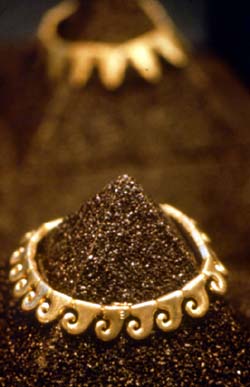
WHY WOULD ANYONE ALLOY GOLD
This is a write-up about why gold is alloyed? Why is it that this precious material is contaminated. Click here to read about it.
To achieve the strength or stability in gold
To achieve color in gold
Workability increases when the gold is alloyed
The cost of metal in a product is reduced considerably
Friday, January 06, 2006
WHY WOULD ANYONE ALLOY GOLD
WHY ALLOY GOLD
Gold in its pure form is yellow in color and is called PURE GOLD or FINE GOLD. Its purity represented in KARAT. It is alloyed or mixed with other metals in a consistent blend for the following most important reasons:
To achieve the strength or stability in gold
- Pure gold is very soft and jewelry made in this kind can easily bend and get misshaped. Fine work such as filigree is usually not recommended in pure gold because it can bend out of shape to irreparable extents fairly easily
- Stones set in pure gold can easily fall out because of the softness of the metal holding them. Most commonly plain gold jewelry is made in 22 K in India and 14K or 18 K in the US.
- To make a product in higher karat gold, the thickness of the product has to be considerably increased to increase its stability. Thus you will land up paying more for the same design made in higher karat gold.
To achieve color in gold
Gold in its purest form is yellow. Gold is often alloyed with other metals such as silver, copper, zinc, palladium etc to achieve a whiter or paler look. “White” gold is an extremely pale color of gold which looks almost white. This is usually created in 18 K gold or lesser purity of gold.
- Normally the bright yellow of pure gold reflects off beautifully on darker skin tones. This makes 22 K yellow gold a popular choice in India as well as Africa. However, pale yellow colored jewelry looks beautiful on most paler or lighter colored skins and hence becomes a popular metal in the US, Italy and Australia. White gold is now a popular choice all over the world due to its publicity and resemblance to platinum.
- Other colors in gold are pink gold, purple, black, green and white. These colors depending on the properties of each are used to enhance design without compensating on the value of the product.
Workability increases when the gold is alloyed
- It is simpler to create solder (material used to join two pieces of gold) for a lower karat of gold rather than struggle with achieving the purity of 24 K gold.
- For a craftsman it is easier to work on lower Karat of gold most of the time if the product has to be hand crafted. He has to be much more attentive so as not to ruin his work when working with fine gold.
- For these above reasons, the making or labor charges may be lesser for a lower karat product in gold.
The cost of metal in a product is reduced considerably
- If in a 18K gold product, the value of metal used is $ 750, then the same design made in 24K gold will be $ 1000. The same design in 9K gold will be $ 375 only. Thus in a fixed budget one can get more if they are willing to compensate on the karat value of the metal.
- Since the weight of gold is more than that of silver or copper, (which is the most common alloying metal for making jewelry) hence the mass of 10gm pure gold will be lesser than that of 9 K gold.
- This means that a 10 gm gold bangle in 24 K is smaller to look at than the same design same weight in 9 K gold.
- Due to its softness, the higher the karat of gold, the faster it gets scratches thus requires more frequent polishing and hence the loss of precious material. This wear and tear makes the product look older sooner.
ABOUT THE ALLOYS
Pure or fine gold is 24 K and theoretically this means that the metal has 100% gold content in it.
But for making jewelry, an example of 18 K gold in terms of “fineness” is the gold content expressed in 750 parts per thousand (75.0% gold). The remaining 25% of the metals in this alloy can vary depending upon the property desired.
But for making jewelry, an example of 18 K gold in terms of “fineness” is the gold content expressed in 750 parts per thousand (75.0% gold). The remaining 25% of the metals in this alloy can vary depending upon the property desired.
The percentage of gold in various alloys is given below (the commonly used Karat values are marked in bold).
- 24 K = 24/24 * 100 = 100 % Gold; no other metal
- 23 K = 23/24 * 100 = 95.83 % Gold; 4.17 % other metals
- 22 K = 22/24 * 100 = 91.66 % Gold; 8.34 % other metals
- 21 K = 21/24 * 100 = 87.5 % Gold; 12.5 % other metals
- 20 K = 20/24 * 100 = 83.33 % Gold; 16.67 % other metals
- 19 K = 19/24 * 100 = 79.16 % Gold; 20.84 % other metals
- 18 K = 18/24 * 100 = 75 % Gold; 25 % other metals
- 17 K = 17/24 * 100 = 70.83 % Gold; 29.17 % other metals
- 16 K = 16/24 * 100 = 66.66 % Gold; 33.34 % other metals
- 15 K = 15/24 * 100 = 62.5 % Gold; 37.5 % other metals
- 14 K = 14/24 * 100 = 58.33 % Gold; 41.67 % other metals
- 13 K = 13/24 * 100 = 54.16 % Gold; 45.84 % other metals
- 12 K = 12/24 * 100 = 50 % Gold; 50 % other metals
- 11 K = 11/24 * 100 = 45.83 % Gold; 54.17 % other metals
- 10 K = 10/24 * 100 = 41.66 % Gold; 58.34 % other metals
- 9 K = 9/24 * 100 = 37.5 % Gold; 62.5 % other metals
- 8 K = 8/24 * 100 = 33.33 % Gold; 66.67 % other metals
Most jewelry worldwide is marked with the caratage or fineness. This may be part of a Hallmark on the jewelry. To read more about Hallmarking and Assaying of gold, please click here.
Something very interesting about gold alloys is that with varying quantity or percentage of alloying metals used, the physical and chemical properties of that alloy can be very cleverly manipulated. A very common use of this fact is that 18 K white gold and 18 K yellow gold has the same content of gold in them, but the color changes. 18 K pink gold is harder to work with than 18 K yellow gold. To read about these differences and how one can use these in their jewelry, click here.
Something very interesting about gold alloys is that with varying quantity or percentage of alloying metals used, the physical and chemical properties of that alloy can be very cleverly manipulated. A very common use of this fact is that 18 K white gold and 18 K yellow gold has the same content of gold in them, but the color changes. 18 K pink gold is harder to work with than 18 K yellow gold. To read about these differences and how one can use these in their jewelry, click here.
Engagement rings for men

The recent query I got:
Is it true that engagement rings for men should not have diamonds? or is this
just a myth? – Miti Garg
To read about this, please click here
Monday, January 02, 2006
Flush Setting
FLUSH SETTING
In this kind of setting, the stone is set completely in the metal so that it looks like its surface is on the same level as the rest of the metal. It is the most stable kind of setting for the safety of the stone.Unfortunately, the stone in this setting has to endure a lot of tension while being set, and if not crafted with experience or care, it can easily get chipped or damaged. Thus the setting cost is a little on the higher side.
 Also, in this kind of setting, the stone looks a little smaller and also the metal covers it enough to retard the light reflected back from it.
The other disadvantage of this kind of setting especially in case of deep cut stones is that the amount of metal used is much more than other conventional settings such as prong or bezel settings. The thickness of the metal has to be more than the depth of the stone, so most big stones are NOT set in this style unless manipulated by design technically.
This kind of setting is usually recommended for tougher stones such as Diamonds, Rubies, Sapphires etc. Almost all stones set in this setting look gorgeous especially when complimented with matte finish. This of course depends on the design itself.
 "Today, jewelry designers view flush setting – sometimes called burnish setting – as an innovative alternative. Freed from the constraints of channel walls, prongs and groupings, flush setting allows a random, almost whimsical, scattering of gem accents." -by Tom Weishaar
Click here to learn how to set a stone in Flush Setting?
Thursday, December 22, 2005
Stones for the Month
Birthstones
A birthstone is a gift of a precious material (jewelry, mainly gemstones; themselves traditionally associated with various qualities) that symbolizes the month of birth (in the Gregorian Calendar) of the birthday boy or girl. It is sometimes also called birthday stone.
There have been many different sets of birthstones used throughout history and in different cultures, but in 1912 the American national association of jewelers, Jewelers of America, officially adopted the following list; it is currently the most widely used list in the United States and many other places, including Australia (a jeweler's 'modern' list states they are selected for bright colors) and Thailand:
- January: garnet
- February: amethyst
- March: aquamarine or bloodstone
- April: diamond
- May: emerald
- June: pearl or moonstone or alexandrite
- July: ruby
- August: peridot or sardonyx and sapphire
- September: sapphire
- October: opal or tourmaline
- November: topaz (any non-blue topaz)
- December: turquoise or lapis lazuli or zircon or blue topaz or Tanzanite
Zodiac stones
This is an astrologic version of the birthstones, using zodiac signs in stead of calendar months of birth, and one completely different stone (the only link) :
- Aquarius : Amethyst and moonstone
- Pisces : Diamond
- Aries : Diamond
- Taurus : Sapphire
- Gemini : Spinel
- Cancer : Emerald
- Leo : Ruby
- Virgo : Opal
- Libra : Peridot
- Scorpio : Aquamarine
- Sagittarius : Topaz
- Capricorn : Garnet
Birthday stones by the week
While this word has also been used as synonym of Birth stone (see above), there is a separate list of assignment according to the day of the week of the recipient's birth:
- Monday : Pearl
- Tuesday : Garnet
- Wednesday : Cat's eye
- Thursday : Emerald
- Friday : Topaz
- Saturday : Sapphire
- Sunday : Ruby
More about these stones
I am updating the information on the various stones mentioned above...
Context of interest about each stone will be mentioned in the following sub-headings...
- History of the stone and various beliefs and significance of the stone
- Value and worth of each stone as compared with other stones
- purchase and pricing tips
- Technical details about the material and composition
- Interesting design and setting recommendations
Thursday, December 08, 2005
Kinds of Stone Settings
What is a setting?
Why are stones set?
Why are stones set?
FACTORS THAT AFFECT OUR CHOICE OF SETTING STONES
The factors that affect the kinds of settings that we use for different jewelry designs are:- Design or the look… the visual appeal
- Kind of stone eg Emerald vs Diamond vs Peridot
- Use of the product. For example a piece being worn for everyday work would not be adorned with precious stones in invisible set.
- Shape of stone
- Cost of setting and damage expected
- Maximum light penetration or reflection for that particular stone eg Kundan vs open setting
COMMON SETTING STYLES USED
- Prong Setting
- Bezel Setting
- Flush Setting
- Channel Setting
- Pave Setting
- Invisible Setting
- Combination Settings
- Some unusual Settings
Thursday, December 01, 2005
Why use gold???
So you are thinking of using Silver !!!
Silver being less expensive than gold, sounds like a more feasible option to use instead of white gold. It values not only lesser in dollars per ounce but is also lighter in weight (mass) and hence lesser quantity will be used to create the same piece when compared to gold. (A 10 gm gold bangle will look bigger when made in 10 gms of silver). Usually in the jewelry market we use sterling silver for all purposes of strength and durability.
However, cost sometimes can truly buy quality. In this case, durability at least!!! Silver tarnishes fairly easily when exposed to the atmosphere due to reaction with sulfur present in minute traces in the air. The brownish tint caused by this reaction can be removed by cleaning with regular silver polish available in the market, however it is a repetitive activity. Also such frequent cleaning of the delicate product may render the stones loose from their setting. Silver is a softer metal than gold thus the prongs built in silver to hold the precious stones as well as the links can easily get damaged. Silver gets scratched easily as well.
Most of all, silver is white and only a temporary gold polish can give it the look of yellow present naturally in gold.
But for those who want the benefit of wearing jewelry crafted beautifully in good looking stones without living with the burden of the extreme expense accompanied, silver is a beautiful metal!!!
In short platinum is more practical metal to make jewelry in for everyday wear such as in wedding bands and engagement rings but for elaborate jewelry such as this one which is not worn so frequently as daily, it may prove to be an impractical expense.
Jewelry however is known to be an aspirational expense and I would not dissuade a person from indulging into platinum for the same reason as all of us love to buy diamonds!!!
However, cost sometimes can truly buy quality. In this case, durability at least!!! Silver tarnishes fairly easily when exposed to the atmosphere due to reaction with sulfur present in minute traces in the air. The brownish tint caused by this reaction can be removed by cleaning with regular silver polish available in the market, however it is a repetitive activity. Also such frequent cleaning of the delicate product may render the stones loose from their setting. Silver is a softer metal than gold thus the prongs built in silver to hold the precious stones as well as the links can easily get damaged. Silver gets scratched easily as well.
Most of all, silver is white and only a temporary gold polish can give it the look of yellow present naturally in gold.
But for those who want the benefit of wearing jewelry crafted beautifully in good looking stones without living with the burden of the extreme expense accompanied, silver is a beautiful metal!!!
Why not Platinum you wonder !!!
It is however a very heavy metal and much more expensive than gold as well. (A 10 gms platinum bangle will look much smaller than a 10 gm gold bangle). The labor costs involved in handcrafting platinum jewelry is way more than the cost of making gold jewelry. The machinery and equipment are also more expensive for platinum jewelry because of more frequent wear and tear and harder quality which is a hidden cost usually involved in manufacturing platinum jewelry.Platinum is more durable than gold and is known for its hardness and it does not get scratched as easy. Thus very fine details (and faults) on the metal can be easily observed in platinum. It sometimes even looks whiter than gold when rhodium polished. Stones set in platinum are fairly safe from falling off because the prongs are relatively stronger and resist bending braking or wearing out. In short platinum is a more practical metal than gold.
In short platinum is more practical metal to make jewelry in for everyday wear such as in wedding bands and engagement rings but for elaborate jewelry such as this one which is not worn so frequently as daily, it may prove to be an impractical expense.
Jewelry however is known to be an aspirational expense and I would not dissuade a person from indulging into platinum for the same reason as all of us love to buy diamonds!!!
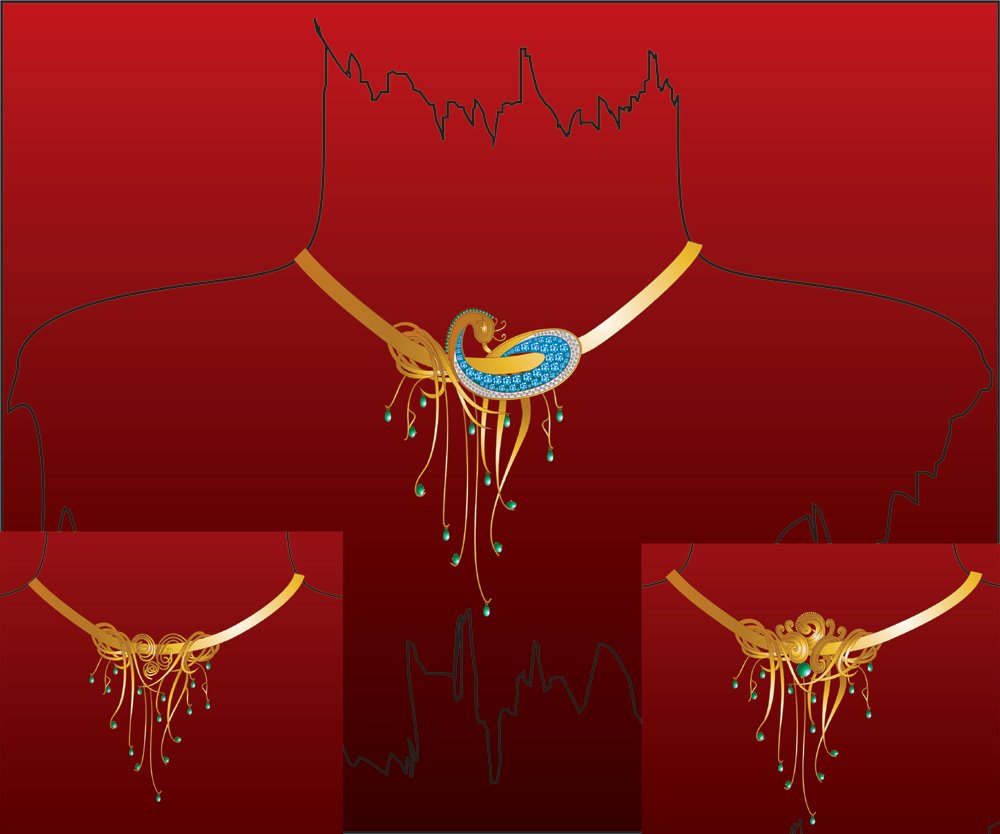
The Rain Dance
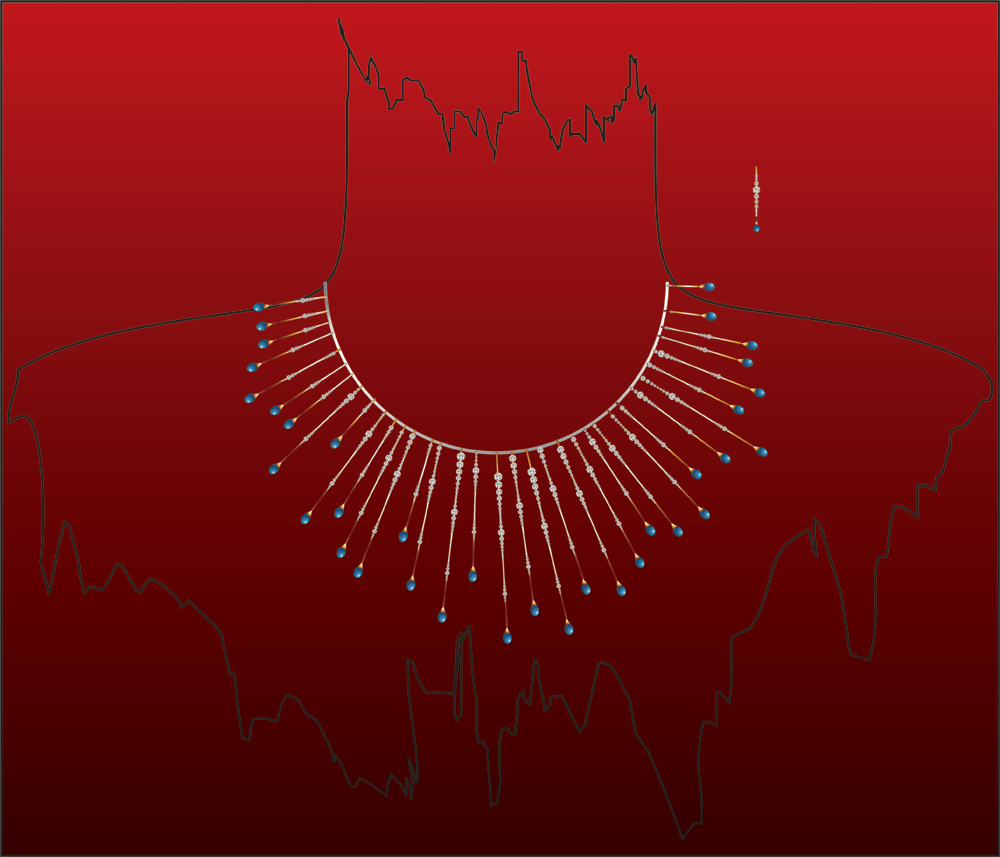
Inspiration
Peacock dancing in the rain
Peacock dancing in the rain
What is it that is so special about the monsoons in India...
The feeling of joy that showers down and back on those longing faces parched with the summer heat. The relief from each moment spent under the smoldering sun with that one anticipation of the cool sounds of water splashing all around. This joy that the monsoons bring to us is reflected most beautifully in the Dance of the Mayur... the Peacock.
I have assimilated my feelings in this one piece of jewelry. The diamonds in all their sparkle are as beautiful as the rain drops. The form is completely adapted from the plumage of a Peacock dancing in the monsoon. Sapphire full of its rich blue gives a hint of his beauty merging perfectly in that wondrous environment.
I have assimilated my feelings in this one piece of jewelry. The diamonds in all their sparkle are as beautiful as the rain drops. The form is completely adapted from the plumage of a Peacock dancing in the monsoon. Sapphire full of its rich blue gives a hint of his beauty merging perfectly in that wondrous environment.
Materials used:
Diamonds and sapphire set in 18K Yellow gold
Diamonds and sapphire set in 18K Yellow gold
This design is completely molded in 18K Gold. I have used yellow gold as the base for the entire product with highlights of white rhodium polish on the prongs holding the diamonds. This makes the Diamonds look Bigger and whiter
Fine quality round brilliant diamonds varying from 0.02ctw to 0.20ctw(image placeholder) is used. The design is subtly given color by setting drop shaped Sapphire in rich velvety color.
Fine quality round brilliant diamonds varying from 0.02ctw to 0.20ctw(image placeholder) is used. The design is subtly given color by setting drop shaped Sapphire in rich velvety color.
Are you considering using alternate metal or stone options?
Some of the other options you can consider for this design in metal can be Silver, Platinum or several other not-so-precious metals such as Stainless steel, Titanium etc. Any of the above mentioned metals can be polished or plated with a yellow metal (may or may not be gold) if desired. Click here to read more.
Diamonds can be replaced by "diamond look alikes" … or can they??? You want to try using some other blue? What about another range of colors for this design lets say Ruby or emerald or aquamarine?
Diamonds can be replaced by "diamond look alikes" … or can they??? You want to try using some other blue? What about another range of colors for this design lets say Ruby or emerald or aquamarine?
Pricing
Gold weightDiamond weight
Sapphire weight
Making charges
Other charges
Contact:
Surbhi S Guptasurbhi.s.gupta@gmail.com
732-986-8132
Sunday, November 27, 2005
Found a new site

This website has very interesting information about cutting of stones and stuff about their origin etc.
The designs are very basic and useful for an everyday wear but fancy a lot of color which makes them pretty appealing.
Must see on this website...
- Location where various stones are found
- How gems are cut
- Intersting tit-bits on gems
- How Jewelry is made
Tuesday, November 22, 2005
History Lesson
Eternity Bands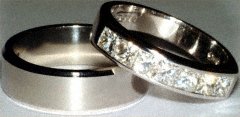

This is a great article about the History of Eternity Bands
More to come on the Eternity Bands as soon as I complete the research on the same from my end.
More to come on the Eternity Bands as soon as I complete the research on the same from my end.
Sunday, November 13, 2005
Thursday, November 10, 2005
Emerald reigns
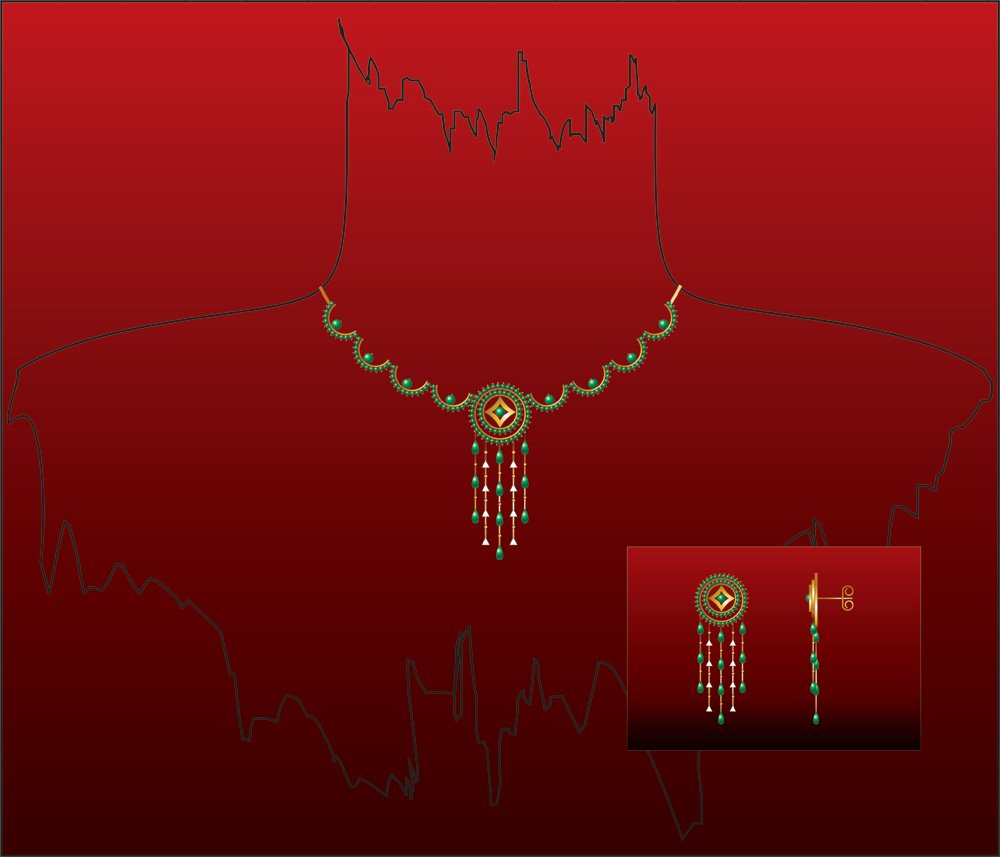
Inspiration
Indian traditional jewelry
This design is purely a reflection of the influence of the Indian design concepts that I have seen people wear over and over again in various forms. The design has a very simple elegance created by the conjunction of the traditional “jhumar” look and the more modern “chandelier” look. Emerald being recognized as “The royal stone” from the ages of kings and princes is of prime importance in this design.
Interesting intricacies
Delicate balance of amount of metal used vs. sturdiness of the product
Interesting switch of stud to a chandelier earring
The necklace is assembled with a simple horizontal link which creates very basic but sturdy flexibility for it to fall comfortably in place around the neck. As you may notice the amount of gold showing around the stones is kept very minimal, you may question the strength of this product. To work on this part, I have made sure that the depth of the gold is a minimum of 0.5 mm which is sufficient to support this design.
The stones are all pierced with the gold knots well rounded to avoid catching fabric and of course give a well finished look.
The earring can be worn as a stud alone or along with the hanging emerald chain component which gives it a more elaborate look.
Even though I would normally recommend a round snake chain for this design, it can completely vary with the personal choice of the wearer.
Materials used
Emeralds set in 18K Yellow gold
This design is completely molded in 18K yellow Gold. Fine quality emerald beads (full as well as half drilled) and gold beads are used.
Emerald, depending on the richness of its “slightly bluish green” color looks best when set against yellow colored metal. At most a few accents of white gold created by rhodium can give a simple shade or twist in the simplicity of the design if used cleverly.
When a fairly good quality emerald is set entirely in white gold, it starts to look paler. However if the color of emerald is extremely dark, it is better to set it open from the back so as to let the light pass and show forth its color. The depth of the setting metal in this case should be kept minimal so as to allow the passage of light through the stone.
Almost all emeralds have fissures or cracks in them naturally. For this reason they are “oiled” (“joban ka tel” as we call in casually in
To learn more about the treatment and care of your emeralds click here.
Are you considering using alternate metal or stone options?
Some of the other options you can consider for this design in metal can be copper, gold plated Silver or several other not-so-precious metals such as alloys of other metals. Any of the above mentioned metals can be polished or plated with a yellow metal (may or may not be gold) if desired. A lower or higher karatage of gold can also be used for the same design. Click here to read more.
Emeralds can be replaced by synthetic emeralds or other green colored stones such as tourmaline, or tsavorite garnets etc. If you want to see this design enriched by another color say blue, pink, red, etc click on the individual colors to see the change and its impact on the design.
Some of the other options you can consider for this design in metal can be Silver, Platinum or several other not-so-precious metals such as Stainless steel, Titanium etc. Any of the above mentioned metals can be polished or plated with a yellow metal (may or may not be gold) if desired. Click here to read more.
Diamonds can be replaced by "diamond look alikes" … or can they??? You want to try using some other blue? What about another range of colors for this design lets say Ruby or emerald or aquamarine?
Pricing
Gold weight
Emerald weight
Making charges
Other charges
Contact
Surbhi S Gupta
Surbhi.s.gupta@gmail.com
732-986-8132
Wednesday, November 09, 2005
Tuesday, November 08, 2005

Monday, November 07, 2005
Sunday, November 06, 2005

Saturday, November 05, 2005

Friday, November 04, 2005
Thursday, November 03, 2005
Tuesday, November 01, 2005

Monday, October 31, 2005
Flight

Inspiration
Flight of a bird
This piece is designed looking at those objects of nature which hold this privilege to fly… to experience. My passion to design jewelry and this dream of flight are both reflected in this design where I have embedded diamonds and Tsavorite garnets in 18K gold.
Materials used:
Diamonds and Tsavorite Garnet set in 18K Yellow gold
This design is completely molded in 18K Gold. I have used yellow gold as the base for the entire product with highlights of white rhodium polish on the prongs holding the diamonds.
Fairly good quality of round brilliant diamonds is used to complete the glittering motion in this design. The lush green of Tsavorite garnet compliments the trail. The three chains are separated using spacers designed in effect for this piece.
Interesting intricacies
Movement in the Tsavorite Garnets
Three chains assembled together using separators
The movement created in the “tail” of the necklace is basically by using vertical linking from behind the metal. The Tsavorite Garnets are set after assembling the gold components in this design. The Garnets are pierced and set very simply in place on Gold wire.
Are you considering using alternate metal or stone options?
This design can be easily cast into other metals such as white gold, platinum or silver. The color of the metal may it be yellow or gold will either ways not change much to the final look of the design.
By using white colored metal, the color of Tsavorite garnet which is not completely “set” but is dangling in the middle of the metal does not get dampened at all. White in this case would help make the diamonds look richer in this design.
The reason why I chose to use yellow gold in this case though was basically to emphasize on the Tsavorite. By using too much white, the diamonds would gain undue attention thus killing the purpose of using Tsavorite.
Pricing
Gold weight
Emerald weight
Making charges
Other charges
Surbhi S Gupta
732-986-8132
My Interests
Anything and everything to do with Jewelry captivates me...
Some other things that grip my senses are
Colors... an assembly of beautiful of colors, what they mean to a mind and more
Forms... what is so breathtaking about one form and why another gets simply ignored. What in our subconcious makes us diverted and reverted to a form
Nature... fresh wild plants, jungles, seasons, water, animals... just about everything from their life to their movement to their beauty
Music... live as well as recorded of all sorts
People... communication, personalities, beliefs and more
Blogging... I love to speak my mind out about my favorite... jewelry
Some other things that grip my senses are
Colors... an assembly of beautiful of colors, what they mean to a mind and more
Forms... what is so breathtaking about one form and why another gets simply ignored. What in our subconcious makes us diverted and reverted to a form
Nature... fresh wild plants, jungles, seasons, water, animals... just about everything from their life to their movement to their beauty
Music... live as well as recorded of all sorts
People... communication, personalities, beliefs and more
Blogging... I love to speak my mind out about my favorite... jewelry
Sunday, October 30, 2005
About me
 PROFILE:
Currently working at developing an information and design house. The site is an encyclopedia to the world of jewlery and design and is aimed at becoming a Design Depot and information for consumers, professionals as well as students in the near future.
www.designdepot.blogspot.com
Working towards building an exclusive clientelle through an upcoming brand sukRitaM
www.sukRitaM.com
Worked as a full time designer at Scott Kay.
www.scottkay.com
Developed the brand Vero India Jewels dealing with export of high end Fine Jewelry from India to Florida.
www.veroindia.com
Worked with Tanishq (leading brand in fine jewelry in India) as a full time designer.
http://tanishq.in/
Over 5 years of experience in Jewelry Design and Development
Strong Expertise in conceptualization of designs and themes and further converting them into creative jewelry
Excellent understanding of Product Development, Materials, Stones and manufacturing processes and Marketability
Experience on designing products based on Forecast, Trends, Market Research and existing design demands
Hands on experience working as a Design Coordinator, coordinating and managing a team of designers and craftsmen to manufacture theme based jewelry
Excellent Communication and Presentation Skills & a perfect team player
Organized & Participated in several Exhibitions & Expos for Fine Jewelry
Good organizational capabilities having worked for developing brands in startup
Fast Learner & a Team Player
SKILLS:
-Highly creative & imaginative in designing
-Sketching, Modeling & Drawing Skills, Color Coordination
-Expert software designing using Corel Draw, Adobe Photoshop & 3D Max
-Skilled in Material Manipulation of all types
-Proficient in Technical Design and CAD
-Form Generation, Bench working, Sculpting
-Computer Document & Presentation using MS Word, MS Power Point, MS Excel
-Skilled Gemologist
-Project Management experience for product development
Events and Exhibitions:
-“Dance of Mayur – An introduction” at Vero Beach, FL on 12 June '04
-“Dance of Mayur – The Showcase” at Vero Beach, FL on 26 Nov '04
-“Accessory Design Show Case: 2001” at New Delhi in Sep’01
Find more about me on
Subscribe to:
Posts (Atom)